PHOTO BOOK FEATURE: JAPAN - A Love Story (Michael Kenna)

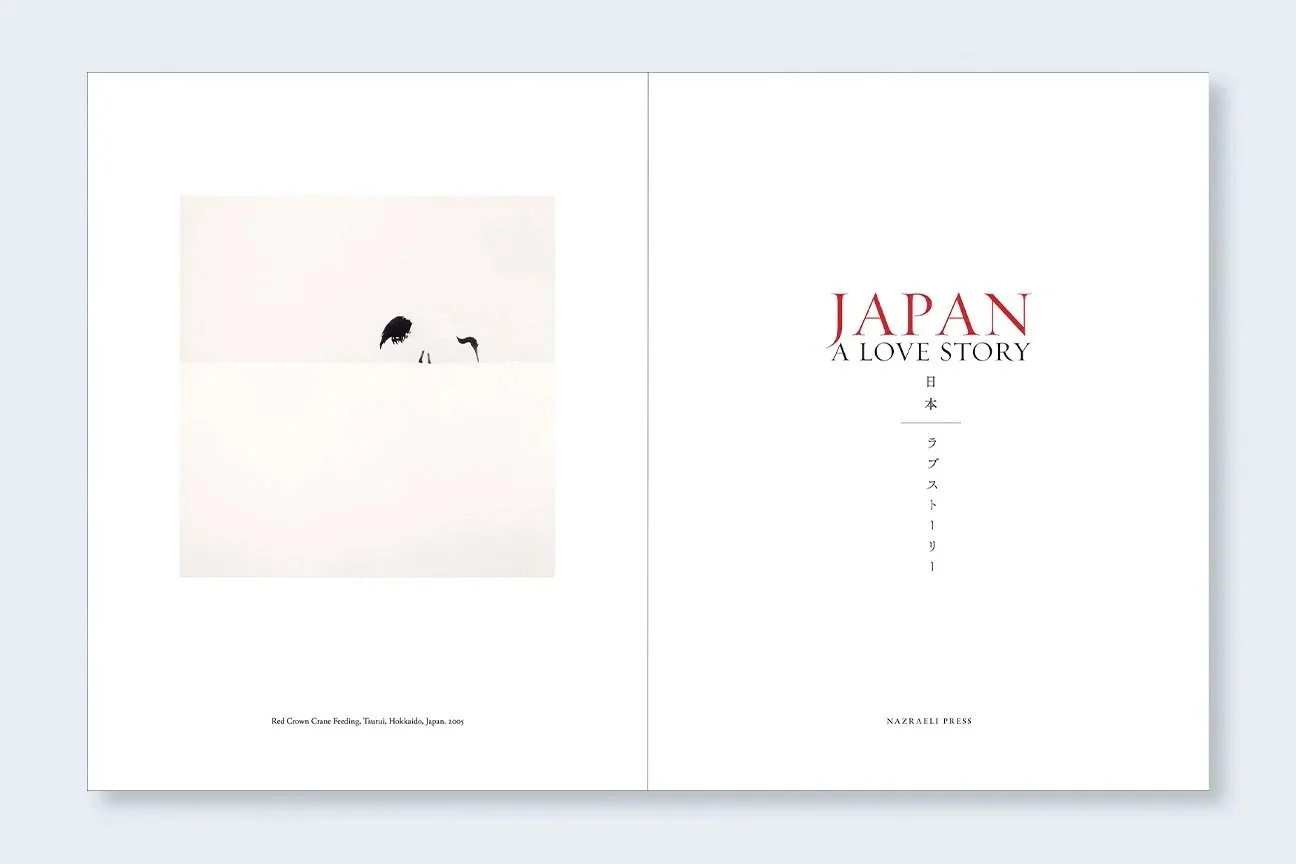
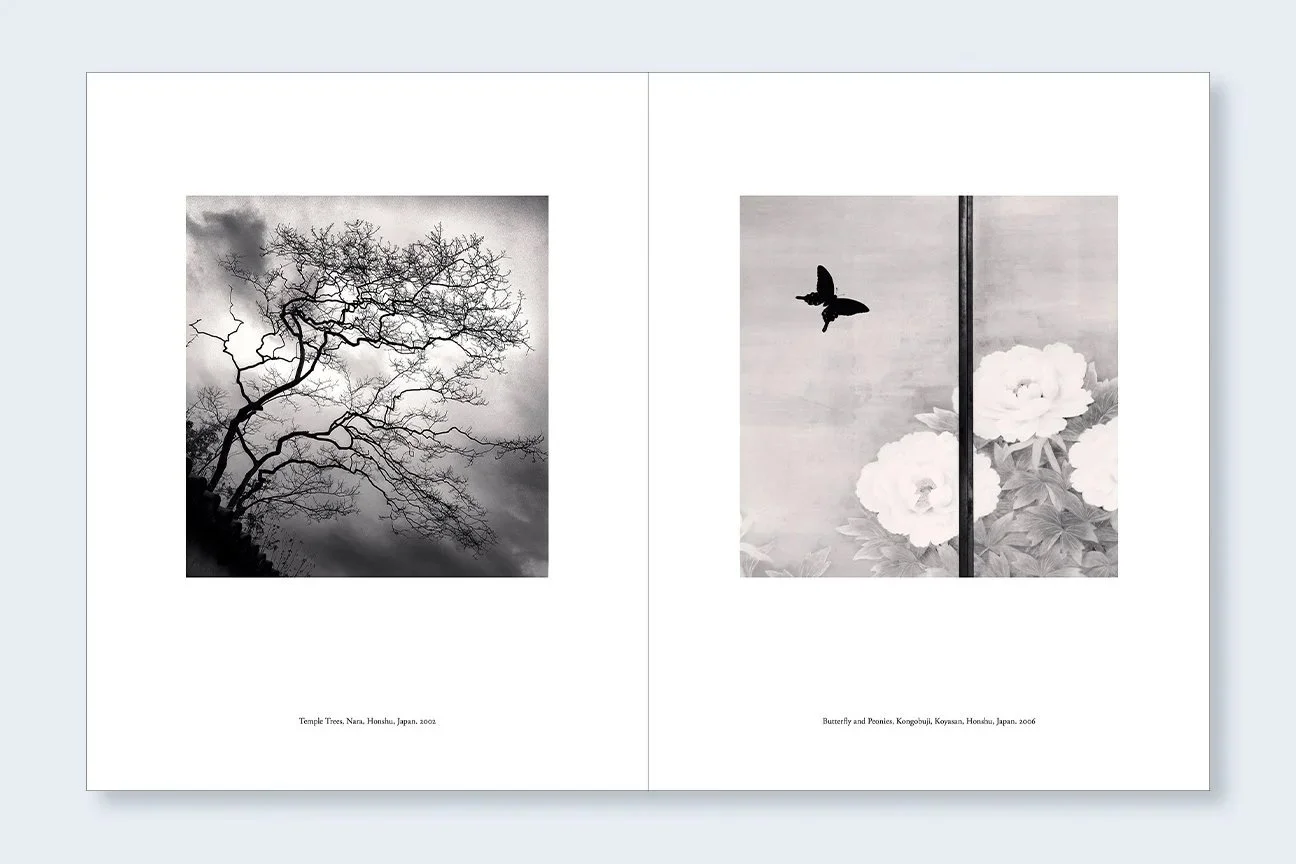
There's something about Michael Kenna's photographs that etches them into your memory. When I visited his exhibition at Japan House in London in October 2024, I found myself drawn into each frame, captivated by the quietude and precision that defines his work. I would imagine that many others who visited the exhibition either left with a book, many books, or many books and a print! I had to be careful to keep my wallet firmly tucked away knowing that the book was already en route to me as a Christmas gift!

ABOUT THE BOOK

JAPAN: A Love Story represents decades of Kenna's patient exploration of the Japanese landscape, and it's a masterclass in restraint. His signature black-and-white aesthetic feels almost destined for Japanese subject matter and cultural influences. The minimalist compositions, the careful attention to form and negative space, the way he captures fog rolling over temple grounds or solitary trees against vast skies: it all speaks to a photographer who truly understands the concept of ma, the Japanese appreciation of empty space.

What struck me most, both at the exhibition and in the book, is Kenna's consistency. He's developed a visual language that's immediately recognisable, yet never feels repetitive. Each photograph feels like a meditation, whether he's capturing the geometric patterns of a Zen garden, the ghostly silhouettes of an ancient temple, or the seemingly quiet and ‘mundane’ moments on a small coastline or lake shore. Everything is so accurately placed yet not at the expense of unfolding rhythms and flow.

The book itself is a beautiful object, as we’ve come to expect from Nazraeli Press releases, something to return to again and again. It's the kind of photography book that rewards slow viewing, where you can lose yourself in the subtle gradations of grey and the contemplative mood that permeates every image. The external cover has a textured fabric feel which adds to the luxurious feel of the whole production. The book also benefits from an interesting foreword by Kohtaro Iizawa the Japanese photography critic. It sets the scene for us to learn more about Japanese aesthetics and also ground Kenna’s work in the long lineage of Japanese art appreciation.

Book Details

  • Title: JAPAN

  • Photographer: Michael Kenna

  • Publisher: Nazraeli Press

  • Pages: 136

  • Images: 100 plates

  • Format: Hardcover

  • Dimensions: 10.5 × 13 inches

  • Year: 2024

IN SUMMARY

If you have any appreciation for fine art photography or Japanese aesthetics, this book deserves a place on your shelf. It's more than a collection of images—it's an invitation to see the world through a more contemplative lens. I’ve seen many ‘look-a-likes’ over the years (probably including myself at certain points!) but there is only one MK and this book in particular is an absolute joy to flick through and lose yourself in.

Oh, and if you ever get chance to see Michael Kenna’s prints in person at an exhibition I say don’t miss it, they are exquisitely printed and framed, just be mindful of your bank balance!

Podcast Appearance: Let's Talk, Let's Create

It was great to recently chat with Mali Davies, a fantastic photographer and all round nice chap. For anyone who knows my history I’m not a stranger to podcasts having hosted and produced 100 episodes of ‘The Togcast’, but it was nice to be the guest rather than the host this time!

This was a chat rather than an interview per se, which is much more enjoyable and I think Mali and I covered a good number of topics. Of course there was quite a bit of discussion about my new book VAIA and I appreciated the chance to dive into some of the story and details a little further. But we also discussed creativity generally and the ups and downs that can come around.

I hope you can find some time to have a listen, I’ve embedded the episode below or you can find it here on Spotify.

Creative Freedom in Landscape Photography

The most powerful tool you have on any photography trip is your imagination. It’s also usually the biggest obstruction. Like any pursuit involving kit, many of us spend the first few years mastering the technical aspects. Here there can often be quick progression and that satisfies our human ‘need to succeed’ but it can also lead to repetition, and conscious craft over-shadowing creative instinct.

Photography in its past was firmly rooted in documenting the scene in front of the lens, be it for historical posterity or factual accuracy, it was about capturing not creating. Nowadays, we can be masters of our own visual destiny, we can create the unseen. Be it through the use of filters, speciality lenses or techniques such as ICM (Intentional Camera Movement) or ME (Multiple Exposures) we can shape time and form, and the possibilities are endless. We can be proactive in sculpting and creating our own visual worlds and scenes.

However, whilst the equipment we use is only limited by our creative boundaries, the use of any technique should only ever be to service the aesthetic goal, it should not dictate it. For this work to be successful it must mean something. That can simply be in pursuit of an aesthetic vision in a single image or as part of a wider story-telling narrative, but it cannot just be a display of technique. 

Try to be open minded in breaking your own mould. Use different approaches to the landscape, find one area to visit multiple times in differing conditions. Observe what’s in a location from the widest possible point of view down to the narrowest few centimetres of sand or stone.

Experiment with movement, both of the camera and of yourself. Learn to manipulate time by experimenting with shutter speeds, challenge your own compositional habits, physically touch and feel what the location is all about. Perhaps even read up on the local history be it 100, 1,000 or 1 Million years old – try and understand a location and then create a body of work which means something deeper and connects to it.

The possibilities are endless – go for it!

SEEING faces in strange places...

How often have you looked up and seen a face or shape in a passing cloud? Or perhaps done a double-take of a strangely familiar looking rock or the rather human looking twist and stance of a ‘dancing’ tree perhaps? Seeing shapes and human forms in the natural world is a fairly common experience, but how much of that can be consciously controlled or sought out? And what does it say about our connections to the natural world?

New-Zealand-24.jpg

Ridgeline ‘Face’

Can you spot the face? The Ridgeline runs down the middle of the shadow and light, highlighting the nose with the eye off to the right catching the late afternoon light…

I recently posted this image from my ‘Aotearoa’ series to Instagram and was delighted when someone commented that they could see a face (can you see it in the Ridgeline? Once you see it, you can’t ‘un-see’ it!) Although I didn’t mention it in the post in this instance, I had spotted the face as well but not at the time of capture, that is to say not consciously at least.

Often I will be reviewing images and certain similarities to human forms will leap out at me, as in this instance. Had the face registered with my sub-conscious in the infinitesimal time our brain reacts to such obvious similarities? After all what we are seeing is shapes that mimic something so ingrained in our visual recognition systems (the layout of a face) that all sorts of things could be happening in the grey matter!

There are times I edit and curate the images, share them and someone pops up with something I simply hadn't seen. So what is this down to and what’s causing us to consciously or sub-consciously be aware of these similarities?

Pareidolia is the name of this phenomenon, or certainly of seeing faces in objects. There are all sorts of resources on the web about this and people far more qualified than I to discuss it. But, for the purposes of photography what’s interesting is whether we can actively seek these out, or whether it’s happening in our sub-conscious and only sometimes revealing itself later.

Mesozoic_Dino.jpg

MESOZOIC ‘FACE’

After months of visiting the same location, on the very last morning this Reptile-like head leapt out at me from the rock below my feet.

The image above (from my MESOZOIC series) was actually the last image shot in the whole series. The images had been made in a very small area of a local beach over multiple visits. All the while I had this story about pre-history, evolution and the time of dinosaurs rumbling around my head. Then, on the very final day and on the way to packing up I just tilted my head and spotted this unmistakable reptilian head in the rock.

There’s no doubt in my mind that because that subject matter was already rooted in my mind I was ‘able’ to decode this shape and pattern into a form that my brain recognised immediately. Had I not been in the throws of that project I’m sure there’s no way it would have leapt out at me.

Alternative ways of seeing and creating imagery in the landscape to evoke similarities or anthropomorphic qualities is nothing new to photography. Both Alfred Stieglitz and Minor White wrote at length about “equivalence”. That is to say, instead of simply depicting the objective and known landscape in a documentary fashion, artists can play visually with non-human subjects (such as clouds, rocks, trees) to show human characteristics or analogies for actions and shapes we understand in the human world. Stuart Franklin writes about this far more coherently than I do in his books ‘Narcissus’ and ‘Analogies’ (Hatje Cantz Publishing) which I would strongly recommend you check out if you’re not familiar with them.

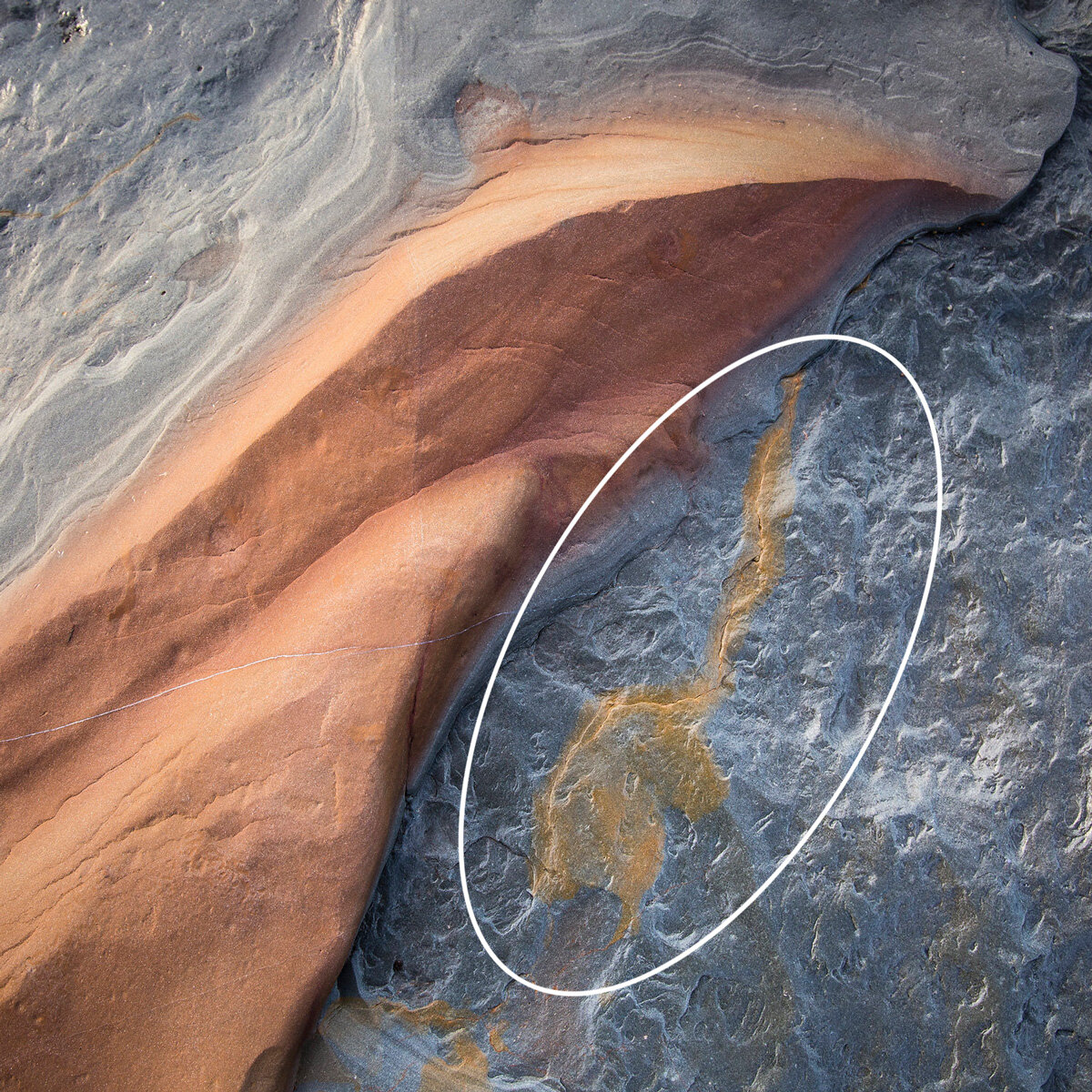
Mesozoic_D.jpg

DIPLODOCUS

Even after months of shooting the work, editing it, curating it and printing it, I had never spotted this Diplodocus shape in the rock.

In the final example above I’ve circled the hidden subject just to help. And, I must admit this is one I hadn’t spotted, which is wonderful! Whilst giving a talk about this body of work someone in the audience pointed out that they saw a Diplodocus in the pattern on the rock. I’d been looking at this work on and off for 2 years, had shot it, edited it, curated it, made a book out of it and never spotted that at all! For me the image was based around that curved ‘wave’ of rock which I linked to the sea and water themes throughout the collection. I was in a sense blinded by my own obsession with that ‘wave’ that I couldn’t see what was right in front of me.

So, a couple of thoughts to end on:

1) I don’t think it’s possible to always go seeking out these shapes or similarities per se. It would be very easy to create a rather contrived body of work if you force it. Rather it often comes from a deeper and more long-term connection with a particular landscape that you grow to know more intimately. Visiting, re-visiting, recognising the changes and subtle differences through the seasons and of shape and form. Without being too much of a hippy about it, I suspect these things sometimes need to come to you when you are in a receptive frame of mind rather than being sought out.

2) Perhaps it’s good to remember that everyone brings their own eyes, thoughts, fears, hopes and visual baggage to each image. I personally think it’s great when viewers pull something different out that even the creator hasn’t spotted. After all, for every smell, taste or feeling we all experience as humans each is 100% unique to ourselves, and I think that’s rather splendid.